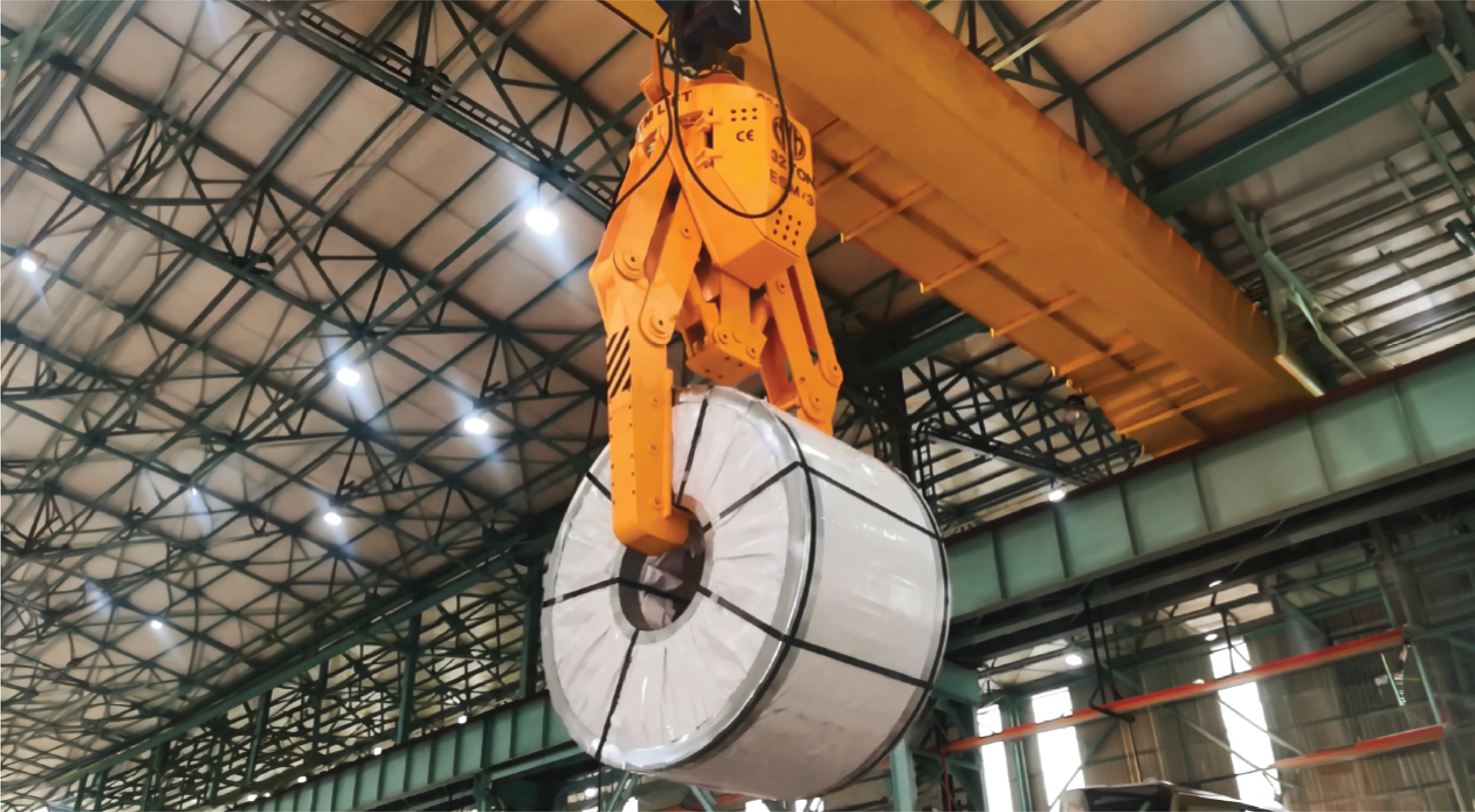
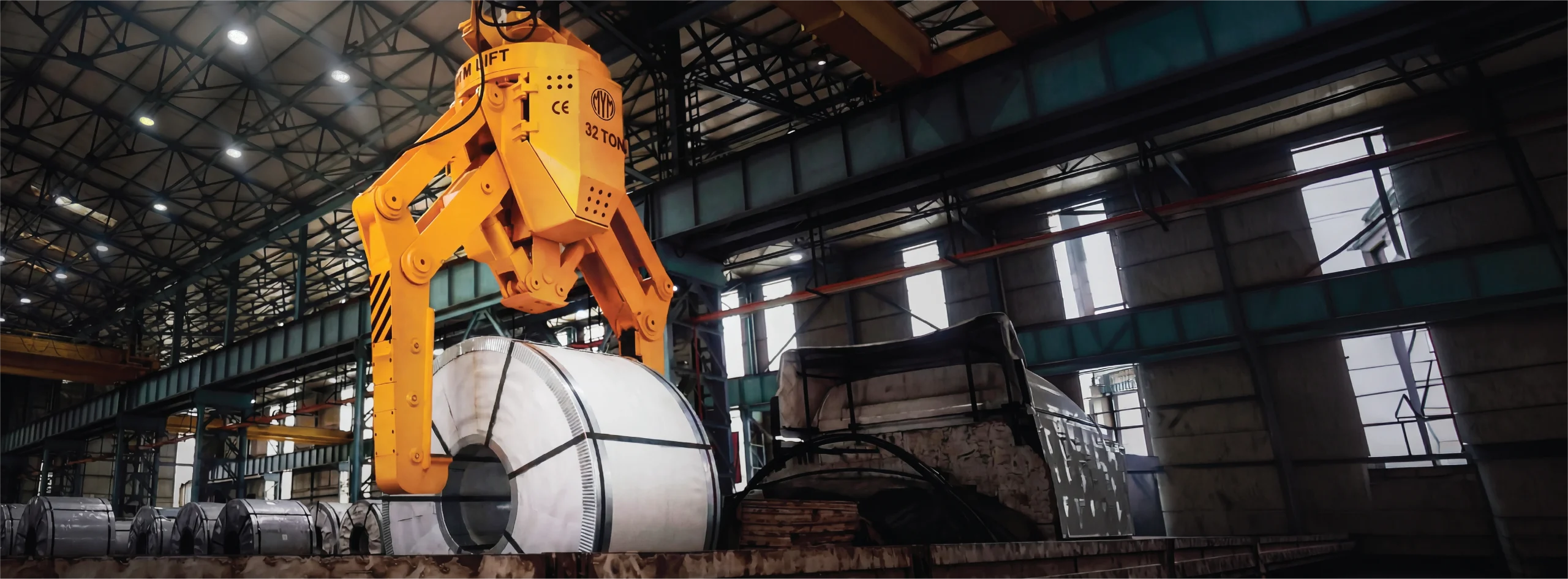
As modern industrial production capacity grows, the weight, size, and operational complexity of the loads that need to be moved and positioned also increase. From iron and steel plants to ports, metal processing facilities, and heavy manufacturing lines, moving heavy loads safely and precisely has become a critical part of industrial operations.
Industrial lifting equipment is therefore more than simply a means of moving loads. These systems are engineering solutions that directly affect production continuity, workplace safety, and operational efficiency.
A properly engineered lifting solution must provide precision, stability, and safety while handling loads weighing several tons.
1. Why Are Heavy Lifting Systems So Important?
Moving heavy loads can represent a significant part of daily operations in industrial facilities.
Steel coils, slabs, large metal components, machinery, and various industrial materials are continuously transported, lifted, or repositioned throughout different stages of production.
Using equipment that is not suitable for the characteristics of the load can negatively affect both operational efficiency and safety.
For this reason, lifting capacity alone is not enough. Load geometry, center of gravity, lifting points, and operating conditions must also be carefully considered.
Every heavy lifting operation has its own engineering requirements.
2. Proper Engineering Is the Foundation of Safety
Safety in heavy lifting equipment begins at the design stage.
It is not enough for equipment simply to be capable of lifting a specified weight. The forces, stresses, and potential deformations that may occur under load must also be accurately calculated.
Material selection, welded joints, connection components, and load-bearing structures should all be designed according to these calculations.
Engineering analysis makes it possible to evaluate how equipment will behave under different load conditions before manufacturing begins.
This means safety is no longer dependent solely on operator awareness; it becomes an integral part of the system’s design.
3. Not Every Load Requires the Same Solution
A standard solution may not always be sufficient for industrial lifting operations.
Lifting a steel coil requires a completely different approach from handling a long slab, pallet, or industrial component with a unique geometry.
For this reason, equipment such as C-hooks, coil tongs, slab tongs, lifting beams, and other load-specific lifting solutions have been developed for different applications.
In some operations, however, standard equipment may not be enough.
When load geometry, working conditions, or production processes create specific requirements, custom-engineered lifting equipment can be developed.
This approach allows the equipment to be designed around the needs of the operation rather than forcing the operation to adapt to the equipment.
4. Why Precision and Stability Matter in Heavy Lifting
When handling loads weighing several tons, even a few centimeters of control can become extremely important.
Particularly on production lines, loads often need to be positioned accurately at specific locations. Uncontrolled movement can damage the load, lifting equipment, or surrounding systems.
Lifting systems must therefore do more than simply carry a load. They must also keep it as stable as possible throughout the movement.
Accurate center-of-gravity calculations and properly designed lifting points help improve load stability.
When precision, balance, and controlled movement come together, heavy lifting operations become safer and more predictable.
5. Durability and Equipment Service Life
Heavy lifting equipment often operates under demanding industrial conditions.
High loads, continuous operation, temperature variations, dust, moisture, and other environmental factors can significantly affect equipment over time.
For this reason, materials and manufacturing methods must be suitable for long-term industrial use.
High-quality structural steels, proper manufacturing techniques, and controlled welding processes help maintain the structural integrity of lifting equipment.
Regular inspections and maintenance also contribute to extending its safe operating life.
Durability is not simply about how strong a piece of equipment is. It is about how reliably that performance can be maintained over many years of operation.
6. The Future of Heavy Lifting: Smarter Systems
The industrial lifting sector is also being transformed by digitalization.
Sensors, load monitoring systems, automation technologies, and real-time data analysis are enabling lifting operations to be managed with greater control and visibility.
In the future, lifting equipment will increasingly operate not only as mechanical systems but also as intelligent systems capable of communicating with the digital infrastructure of production facilities.
Real-time load monitoring, equipment condition tracking, and predictive maintenance can significantly improve both operational safety and efficiency.
As technology continues to advance, heavy lifting operations will become safer, more precise, and more predictable.
Engineering Behind the Power
From the outside, heavy lifting may appear to be an operation driven simply by powerful equipment.
However, safely moving a load weighing several tons requires engineering calculations, appropriate material selection, precision manufacturing, and comprehensive quality control.
As modern industry continues to expand, the need for reliable lifting systems will continue to grow.
Because moving heavy loads is not simply a matter of strength.
True power comes from control, precision, and proper engineering.